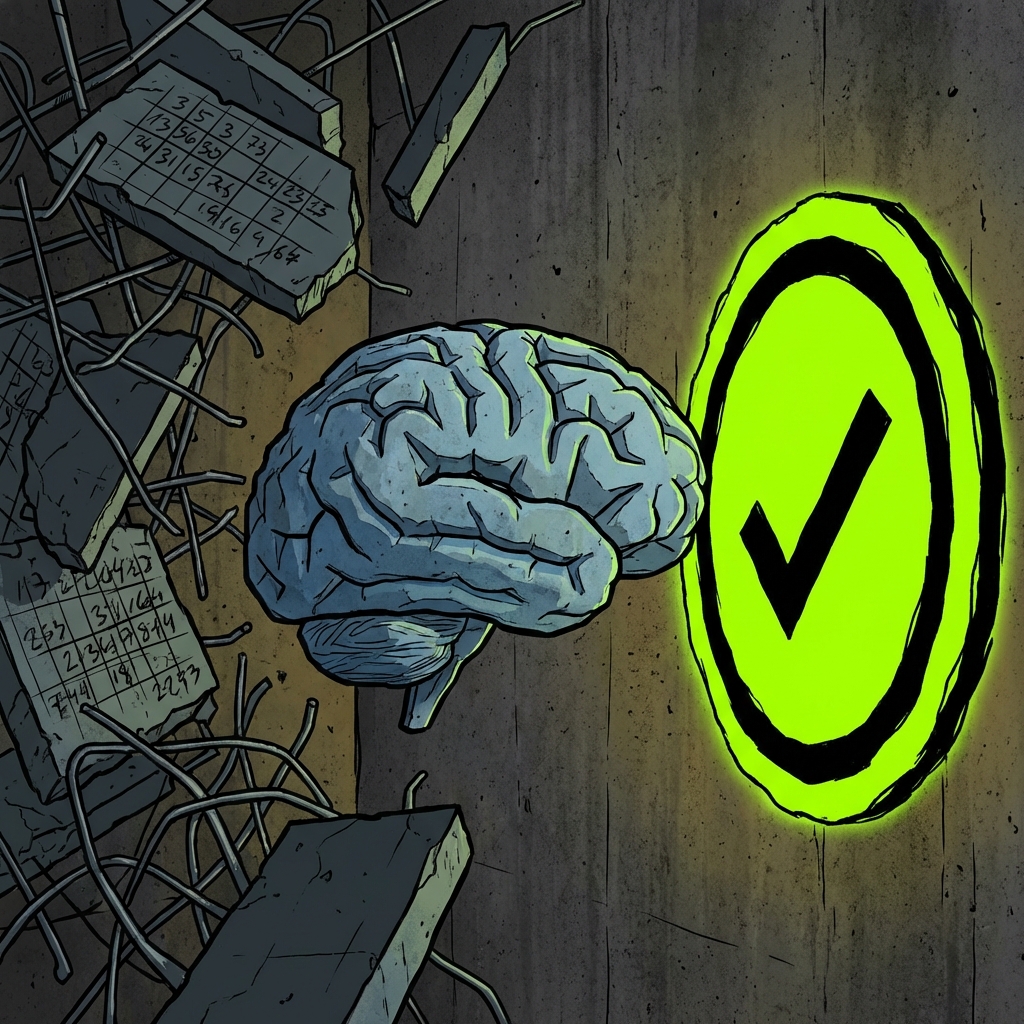
Your brain is a pattern-recognition machine that evolved over millions of years to make split-second survival decisions. It was not designed to calculate whether 487 calories plus 23 grams of protein fits into your daily macro budget.
Yet that's exactly what traditional dieting asks you to do—multiple times a day, every single day. And then it wonders why you quit after two weeks.
The Traffic Light Test: How Your Brain Actually Works
Imagine you're driving and you see a red light. Your brain doesn't calculate the wavelength of light (620-750 nanometers), cross-reference traffic laws, or perform a risk assessment. It just knows: Stop.
Now imagine if every traffic light was replaced with a digital display showing: "Current intersection danger level: 7.3 out of 10. Recommended deceleration rate: 4.2 m/s². Proceed with caution coefficient of 0.68."
You'd crash within a week. Not because you're incapable of understanding the numbers, but because your brain wasn't built to process information that way under time pressure.
"Visual signals bypass the part of your brain that does math. They speak directly to the part that makes decisions."
Decision Fatigue: The Silent Diet Killer
Every time you look at a calorie count, your brain has to do work:
- Retrieve your daily calorie target from memory
- Calculate how many calories you've already consumed
- Subtract to find your remaining budget
- Evaluate whether this food "fits"
- Make a decision: yes or no
That's five cognitive steps for a single piece of food. Do that 20-30 times a day, and you've just added a part-time job to your life. Except this job pays in anxiety instead of money.
Decision fatigue is real. It's why judges give harsher sentences before lunch and why you're more likely to order takeout at 8 PM than 8 AM. Your brain has a limited capacity for decisions, and calorie counting drains that tank fast.
The Green Light Effect: Instant Clarity
Now imagine this instead: You open your app. You see a green bar at 42%. That's it. No math. No memory recall. No mental gymnastics.
Your brain instantly knows: You're good. Keep going.
This is the power of visual feedback. It eliminates the question "Can I eat this?" and replaces it with a signal your brain can process in milliseconds. Green means go. Yellow means caution. Red means you're over budget—but even that's just information, not judgment.
Why Green Specifically?
Green is universally associated with "safe," "go," and "positive." It's not a coincidence that traffic lights, hospital signs, and battery indicators all use green to signal "everything's okay."
Your brain has been trained by thousands of environmental cues to trust green. When you see it, your stress response doesn't activate. You don't second-guess. You just move forward.
The Anxiety Loop: Numbers Create Uncertainty
Here's what happens when you see "1,847 calories remaining":
- Is that a lot? Is that enough for dinner?
- What if I estimated my lunch wrong?
- Should I save more for tomorrow?
- What if I'm still hungry later?
Numbers create uncertainty because they require interpretation. They demand that you become your own nutritionist, mathematician, and fortune-teller all at once.
Visual cues, on the other hand, are binary. You're either in the green zone or you're not. There's no room for overthinking because there's nothing to overthink.
"Removing uncertainty doesn't just reduce stress—it removes the primary reason people quit diets."
Cognitive Load: Why Simplicity Wins
Your brain has two systems for processing information:
- System 1: Fast, automatic, intuitive (the traffic light system)
- System 2: Slow, deliberate, analytical (the calorie calculator)
Traditional dieting forces you to live in System 2 all day long. That's exhausting. It's like trying to drive a car by manually calculating every turn angle and acceleration rate.
Visual tracking lets you operate in System 1. You glance at a color, and your brain instantly knows what to do. No calculations. No mental overhead. Just a signal.
The Feedback Loop: Instant Reinforcement
When you log a meal and see your percentage go from 42% to 58%, your brain gets instant feedback. Not in the form of guilt or anxiety, but in the form of objective data.
This creates a positive feedback loop:
- You eat → You see the impact immediately
- You stay in the green → Your brain registers a "win"
- You feel in control → You're motivated to continue
Compare that to calorie counting, where the feedback is: "You have 1,360 calories left." What does that even mean? Is that good? Bad? Should you celebrate or panic?
Numbers don't motivate. Signals do.
Your Brain Wasn't Built for Spreadsheets
The human brain evolved to recognize patterns, not to perform arithmetic. We're wired to see a ripe fruit and know it's safe to eat. We're wired to see a predator's eyes in the dark and know to run.
We are not wired to track macronutrients across 47 different food items while simultaneously managing work stress, family obligations, and the mental load of modern life.
The reason visual tracking works isn't because it's "easier" in some vague sense. It works because it aligns with how your brain actually processes information. It removes the cognitive friction that makes traditional dieting feel like a second job.
Green means go. Numbers mean overthink. Your brain already knows which one it prefers.