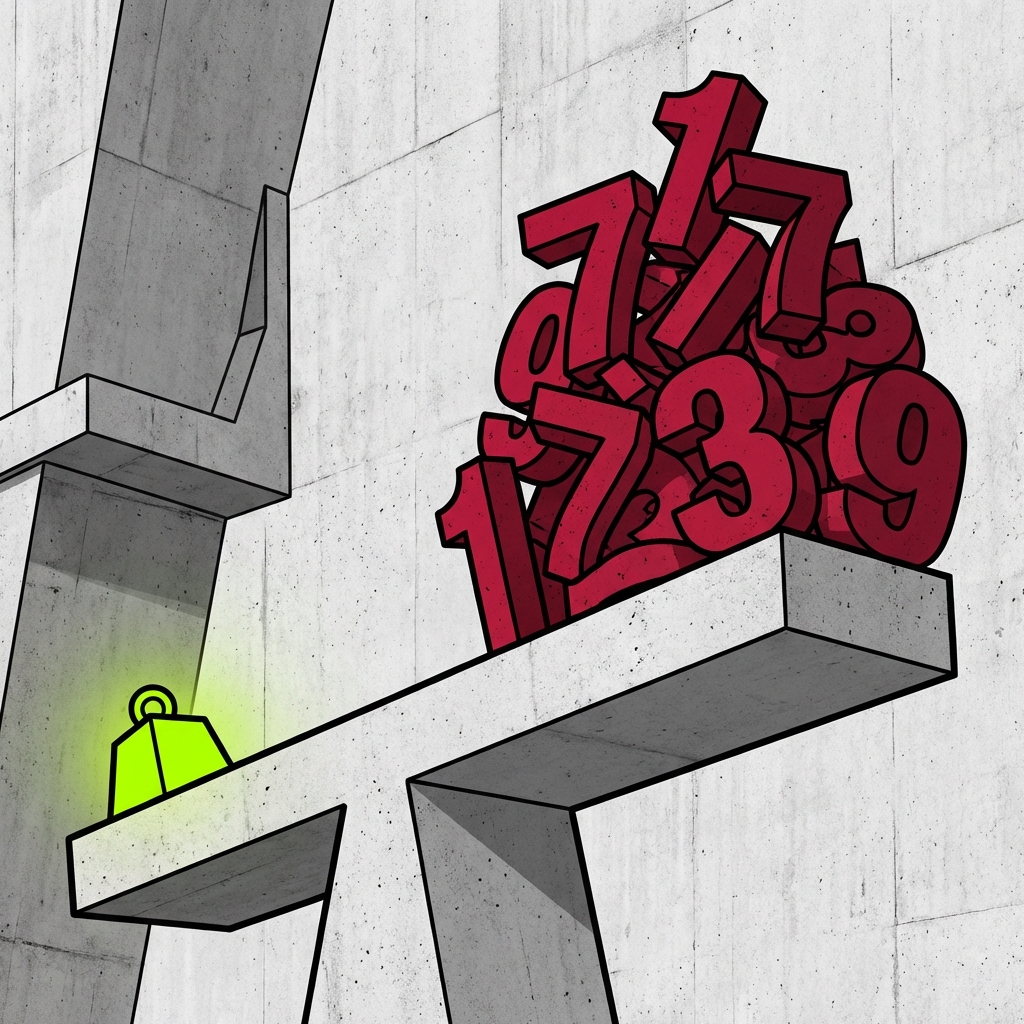
If you’ve ever tried to lose weight, you’ve likely been handed a spreadsheet and told it was a lifestyle change. You’ve been sold the idea that successful weight loss requires the precision of a laboratory experiment.
But there is a reason the average person abandons traditional calorie tracking within just 14 days. The failure isn't yours; it’s the system.
The Burden of 2,000+ Numbers
Traditional dieting is a full-time data entry position with no salary. It asks you to track total calories, protein, carbs, fats, fiber, sugar, sodium, and water intake—all while managing meal timing.
This creates a phenomenon called "decision fatigue". Consider the simple act of eating an apple:
- The Traditional Way: You must estimate its size, search a database of 47 entries, weigh it, and perform mental math. That is six cognitive steps for a single piece of fruit.
- The Result: By the time you’ve finished this mental gymnastics routine, you’ve lost ten minutes of your life and added a layer of "mathematical theater" to your day.
"Furthermore, this precision is an illusion. You are measuring your progress with a 'ruler made of rubber'."
The Hero: The Single Metric
The Percentage Method is the "noise-canceller" of weight loss. It transforms your complex caloric needs into a simple 0–100% budget.
| Feature | Traditional Counting | Percentage Method |
|---|---|---|
| Complexity | 1,847 - 487 = 1,360 remaining | 24% used, 76% remaining |
| Feedback | Text-heavy, data-rich, confusing | Visual, color-coded bars |
| Effort | 15-20 mins of logging / day | 2 seconds per meal with Point & Snap |
| Mindset | All-or-nothing, guilt-driven | Objective, forgiving |
Why Simplicity Wins the Long Game
Behavioral science shows that friction kills consistency. Every extra step between you and your goal is an opportunity to quit.
The Percentage Method succeeds because it meets your brain where it is naturally strong: processing visual proportions rather than doing active arithmetic. When you see a green bar at 40%, you instantly know where you stand without needing to interpret a single digit.
Weight loss isn’t a math problem—it’s a behavior problem. You don't need more data. You need less noise.